



Many healthcare facilities do not recognize that there is a billing issue until the financial strain becomes too great to overlook. Perhaps payments are delayed, or denial of claims is happening more frequently, or maybe revenue has been unpredictable lately without any fluctuation in the number of patients.
At first, it is easy to blame insurance companies, staffing shortages, or changing payer rules. And yes, those factors matter. But in many cases, the deeper issue is hidden somewhere inside the billing process itself.
That is where a medical billing audit becomes incredibly valuable.
5 Signs Your Practice Needs a Medical Billing Audit
A comprehensive audit will reveal revenue leakage, coding problems, denial patterns, workflow problems, and compliance risks before they turn into big financial issues. No matter which source you consult, denied claims, coding problems, and older accounts receivable are among the most significant problems identified in the revenue cycle.
So how do you know when your practice has reached that point?
Here are five clear warning signs.
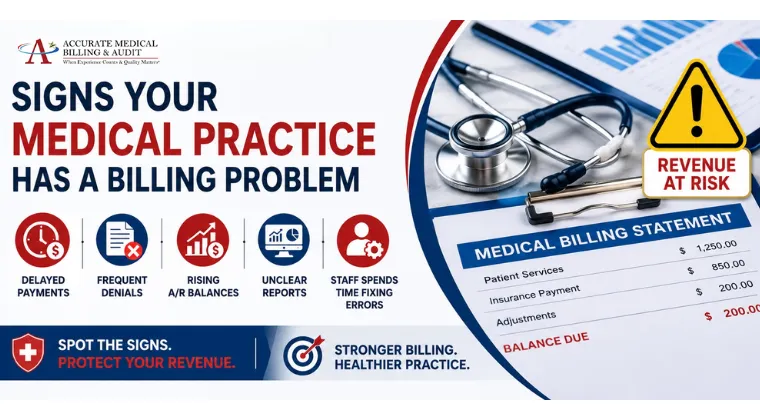
1. Your Claim Denials Keep Increasing
All practices have faced some level of denials. It is perfectly normal. However, if there are denials regularly or even worse, it is normally a sign of a significant billing problem that should be addressed. Some of the most common reasons for denied claims within healthcare organizations range from eligibility errors to missing authorizations, incorrect coding, documentation issues, or filing errors.
But the real issue is that denials have come in a chain:
- Delayed reimbursements
- Increased administrative work
- Higher write-off risk
- Staff burnout
- Interrupted cash flow
And there is this part that many practices miss out on: denied claims will show patterns.
A medical billing audit helps identify:
- Which denial categories occur most often
- Which payers reject claims repeatedly
- Whether front-end intake or coding workflows are causing issues
- Which claims are recoverable versus permanently lost
Without auditing those patterns, the same mistakes tend to repeat month after month. Many revenue cycle experts now emphasize denial prevention, not just denial correction, as the smarter long-term strategy.
2. Your Accounts Receivable Is Growing Older
If your accounts receivable keeps climbing past 60 or 90 days, that is a major warning sign. Healthy revenue cycles move claims through quickly. When aging A/R starts growing, it usually means claims are getting stuck somewhere in the process.
That could involve:
- Slow follow-up on unpaid claims
- Incomplete appeals
- Submission delays
- Understaffed billing teams
- Incorrect payment posting
- Missing documentation
Over time, older balances become harder and sometimes impossible to collect. Revenue cycle specialists consistently identify growing A/R as one of the clearest indicators that billing operations are underperforming. A billing audit helps uncover exactly where the bottlenecks exist. Sometimes the issue starts at patient registration.
3. Revenue Feels Lower Despite Stable Patient Volume
This one catches practices off guard all the time. The schedule is full. Providers are seeing patients consistently. Yet collections somehow feel lower than expected. That disconnect often points to silent revenue leakage.
Revenue leakage happens when practices lose money gradually through:
- Under-coded visits
- Missed charges
- Unappealed denials
- Incorrect modifiers
- Payment undercalculations
- Credentialing problems
- Incomplete documentation
And because these losses happen quietly across hundreds or thousands of claims, they’re easy to miss without a formal audit process. Some industry reports estimate that healthcare organizations may lose substantial collectible revenue through preventable billing and coding errors.
4. Your Staff Spends Too Much Time Fixing Billing Problems
You can usually tell when a billing system is reactive instead of proactive. Staff members constantly resubmit claims. Correct demographic errors. Chase is missing documentation. Call payers repeatedly. Appeal preventable denials.
Everyone feels busy, but progress still feels slow. That is often a workflow problem, not just a staffing problem. According to revenue cycle specialists, practices experiencing repetitive billing corrections often have upstream process failures affecting the entire reimbursement cycle.
A medical billing audit helps determine:
- Where errors originate
- Which workflows create repeat problems
- Whether internal processes are outdated
- Which tasks should be automated or standardized
Sometimes the issue is not your billing team at all. Sometimes they are simply overwhelmed by preventable errors happening earlier in the process. And over time, that environment creates burnout, slower turnaround times, and more mistakes.
5. Lack of Visibility into Your Financial Performance
It happens more often than you would expect. Reporting is there, but it does not give any useful insights.
For example, you may know how much revenue you make overall without having answers to:
- Why some payments are denied
- Which payers lag behind
- What codes lead to denials
- How much revenue is tied up in A/R
- If collections are on par with your expectations
Lack of visibility will force you to be reactive rather than proactive. That is where an audit will provide a better view of your medical practice’s finances, by evaluating your billing process, payers’ conduct, coding, and reimbursements.
The Importance of Medical Billing Audits in 2026
Healthcare billing has become increasingly complex. Between changing payer rules, tighter documentation requirements, coding updates, and growing administrative pressure, even well-run practices can develop hidden billing inefficiencies over time.
And unfortunately, many revenue problems do not appear as dramatic failures.
They build quietly:
- Slightly slower reimbursements
- Gradually rising denials
- Increasing staff workload
- Small revenue losses spread across thousands of claims
When those problems are noticeable, the monetary cost could be considerable. A billing audit lets practices take a step back to review the revenue cycle and opportunities to enhance the collections process, decrease denials, improve compliance, and improve practice efficiencies.
Conclusion
Billing audits for healthcare providers are not limited to situations where the medical practice is already in poor financial condition. Most of the time, the audit serves as a preventive measure in revealing underlying inefficiencies in the business operation.
When you start seeing denials, old accounts receivable, irregular cash flow, and persistent difficulties when it comes to billing processes, these signs might be an indicator that you need to conduct a review of your revenue cycle operations.
Practices looking to enhance their revenue cycle performance and unearth inefficiencies in their billing can rely on Accurate Medical Billing & Audit to take care of their auditing needs through comprehensive auditing services.