




For growing clinics, inefficiencies in revenue cycle management (RCM) can quietly disrupt operations—leading to delayed reimbursements, rising claim denials, and inconsistent cash flow.
While patient care remains the top priority, the financial backbone of your practice depends on how efficiently your healthcare revenue cycle is managed. A single gap in the process—whether in patient registration, coding, or collections—can impact your entire revenue stream.
This guide explains the complete RCM process, common challenges, and best practices to help clinics reduce claim denials, improve cash flow, and scale efficiently.
What Is Revenue Cycle Management (RCM)?
Revenue Cycle Management is the process of managing patient revenue from the initial appointment scheduling to the final payment collection.
It includes every financial interaction within your practice:
- Patient registration
- Insurance verification
- Medical coding
- Claims submission
- Payment posting
- Collections and follow-ups
RCM is not a single function—it is a connected system where each step directly affects the next.
The Importance of RCM for Growing Clinics
Growth sounds great, until your billing system can’t keep up.
As clinics expand, they often face:
- Increased claim volumes
- More complex payer requirements
- Higher risk of billing errors
- Delayed reimbursements
Without strong RCM, revenue leaks quietly.
An efficient system helps you:
- Get paid faster
- Reduce claim denials
- Improve cash flow
- Make better financial decisions
In simple terms, good RCM does more than support growth. It sustains it.
Key Stages of the Revenue Cycle Management Process
RCM is not one task. Rather, it is a chain of connected steps, and each one matters.
1. Pre-Registration and Scheduling
This is where everything starts. Patient information is collected, and appointments are scheduled. If a mistake happens here, such as incorrect details, it can lead to claim rejections later.
2. Insurance Verification
Before the visit, you confirm:
- Coverage status
- Benefits
- Patient responsibility
This step alone can significantly reduce denials.
3. Charge Capture and Documentation
After the visit, every service provided must be accurately recorded. Missed charges result in lost revenue, and incomplete documentation causes delayed payments.
4. Medical Coding
This is where clinical care turns into billable documentation. Coders convert the care provided into codes. One mistake in this area and you could have your claim denied or delayed.
5. Claims Processing
Once your claim has been coded, it must be submitted to an insurance company. And the aim? Submitting a “clean claim,” which means an accurate and complete claim.
6. Payment Posting and Adjudication
Insurance companies review claims and issue payments.
Your team then records:
- What was paid
- What is pending
- That is the patient’s responsibility
7. Denial Management and Collections
Not all claims get approved.
Denied claims need to be:
- Reviewed
- Corrected
- Resubmitted
At the same time, patient balances must be collected efficiently. These steps, when handled well, directly impact your bottom line.
Common Revenue Cycle Challenges in Clinics
Even well-run clinics face RCM challenges that impact financial performance.
Typical issues include:
- High claim denial rates
- Inaccurate patient data
- Coding errors
- Slow reimbursement cycles
- Inefficient collections
These problems often go unnoticed until revenue is affected.
Best Practices to Improve Your RCM Process
Strengthen Front-End Processes
Accurate patient data and insurance verification reduce errors before they start.
Focus on Clean Claims
Invest in proper coding and claim scrubbing to minimize rejections.
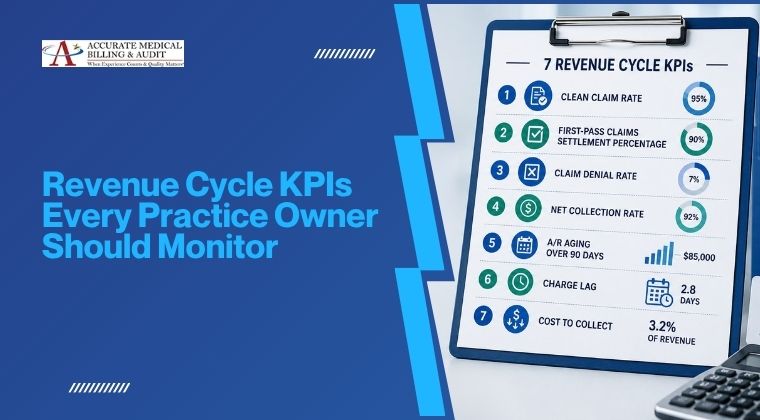
Monitor Your Vital Metrics
Vital metrics to monitor include:
- A/R days
- Denial rates
- Collections rates
Your metrics will point out areas that need attention.
Apply Technology Strategically
Technology can optimize operations and minimize mistakes.
Perform Audit Checks
Audits can help detect weaknesses and enhance compliance.
In-House vs Outsourced Revenue Cycle Management
This is where many clinics get stuck. Deciding which is better between in-house RCM and outsourcing.
In-House RCM
- Greater control
- Requires skilled staff
- Higher operational costs
Outsourced RCM
- Access to experienced professionals
- Reduced administrative burden
- Scalable as your clinic grows
For many clinics, outsourcing becomes the smarter option as complexity increases.
How RCM Impacts Patient Experience
Here is one of the things that are usually forgotten: patients are also influenced by RCM.
Clearly billed, correctly estimated, and hassle-free payment:
- Build trust
- Reduce confusion
- Improve satisfaction
Since a great patient experience does not stop when they leave care, but continues through billing.
The Future of Revenue Cycle Management
RCM is evolving with technology and data-driven strategies.
Clinics can now:
- Predict claim denials
- Automate billing workflows
- Improve financial forecasting
However, success depends not just on tools—but on consistent processes and expert execution.
Conclusion
Revenue Cycle Management is not just a billing procedure but the financial support of your clinic. All the processes, such as registering a patient, up to the last payment, contribute to the efficiency of your practice’s functioning and development.
In the case of expanding clinics, the distinction between underperforming and thriving can be reduced to the effectiveness of the revenue cycle.
When you are willing to lower the number of denials, enhance cash flow, and streamline your whole billing exercise, then collaborate with Accurate Medical Billing. Working with a team of experts offers specialized RCM solutions to help your organization grow and optimize your revenues so that you can do what is most important to you, patient care.