


Being successful with your medical practice isn’t only about providing your patients with top-quality healthcare; it’s also about ensuring your bottom line is healthy. But most practice owners don’t become aware of a revenue issue until there’s a slowdown in cash flow, an increase in accounts receivable or an increase in claim denials.
Tracking the appropriate Key Performance Indicators (KPIs) can help you find billing inefficiencies quickly, work more efficiently on collections, and make better-informed decisions that can help support your practice’s financial health.
Every practice owner should keep an eye on these 8 revenue cycle KPIs because they provide valuable insights into your practice’s financial performance.
Days in Accounts Receivable (A/R)
Days in A/R is the average amount of time it takes to collect payment after services are provided. A higher number may indicate delayed claims, payer issues or ineffective follow-up.
Why it matters
The longer payments are uncollected, the more cash is tied up in outstanding balances, leaving less cash available to pay employees, purchase supplies, invest in new technology, or cover your practice’s operating expenses.
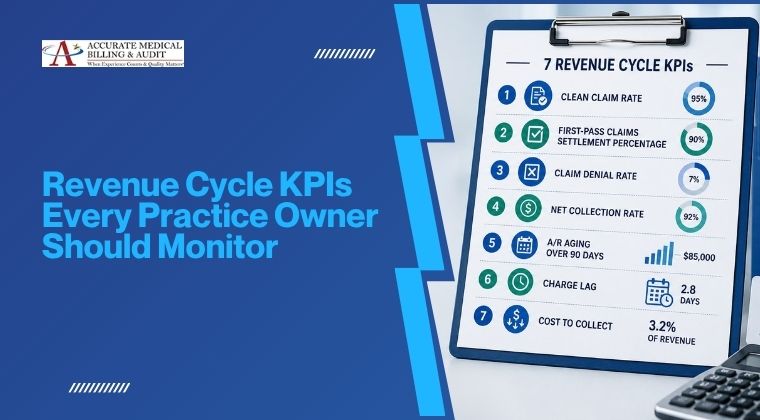
1. Clean Claim Rate
The Clean Claim Rate is the percentage of claims that are submitted correctly the first time, without requiring corrections due to missing information or errors. Every claim error can result in unnecessary payment delays.
Common causes include:
- Missing patient information
- Incorrect coding
- Eligibility verification errors
- Documentation issues
- Missing authorizations
Why it matters
If a high clean claim rate, then it follows:
- Faster reimbursements
- Fewer denials
- Reduced administrative workload
- Improved cash flow
Many organizations aim for a minimum Clean Claim Rate of 95%.
2. First-Pass Claims Settlement Percentage
This KPI measures the percentage of claims paid on the first submission without requiring resubmission or an appeal. While similar to the Clean Claim Rate, this metric focuses on successful payment rather than error-free submission.
Why it matters
- Higher payment rates at the first attempt result in reduced:
- Administrative expenses
- Rework
- Payment delays
- Workload
These are achieved through better front-end processes such as reduced problems with patient registration, improved coding accuracy and better insurance validation.
3. Claim Denial Rate
The Claim Denial Rate is the percentage of claims that are denied by payers. For each of these denied claims, there is a need to invest more staff time in investigating, correcting, appealing and resubmitting.
Common denial causes:
- Incomplete documentation
- Coding mistakes
- Insurance eligibility issues
- Authorization problems
- Timely filing deadlines
- Medical necessity concerns
Why it matters
If left unresolved, even a handful of denials can reduce monthly revenue. Many practices aim to keep denial rates under 5% and monitor denial trends by payer and denial reason to identify recurring issues.
4. Net Collection Rate
Net Collection Rate is the amount of revenue your practice collects after contractual adjustments, as a percentage of the amount collected. This KPI is different from total collections because it reflects the effectiveness of your billing process in collecting the revenue owed to your practice.
Why it matters
The decreasing Net Collection Rate can signal:
- Poor follow-up
- Unresolved denials
- Underpayments
- Missed filing deadlines
- Inefficient patient collections
Organizations that are successful often aim to achieve a NCR of 95% or more.
5. A/R Aging Over 90 Days
Not all outstanding accounts are equally concerning. This KPI shows what percentage of accounts receivable are over 90 days overdue.
Why it matters
As the balance increases, the older it gets, the harder it is to collect. Ageing reports will enable billing teams to identify the ageing of accounts, and resolve them first rather than them becoming bad debt.
Many A/R with over 90 days balance outstanding could indicate:
- Delayed follow-up
- Inefficient collections
- Payer disputes
- Unresolved denials
Many practices strive to keep A/R over 90 days below 15–20% of total accounts receivable.
6. Charge Lag
Charge Lag is the amount of time it takes for the patient to receive care and for charges to be entered into the billing system. Any lag time can impact the entire revenue cycle.
Why it matters
Long charge lag periods could lead to:
- Slower claim submission
- Delayed reimbursements
- Guarantees that deadlines for filing will be missed.
- Reduced cash flow
The efficient practices quickly submit the charges in one to three days or the same day if possible.
7. Cost to Collect
Cost to Collect refers to the amount of money that your practice spends to collect.
It covers costs of:
- Billing staff
- Billing software
- Clearinghouse fees
- Outsourced billing services
- Collection activities
Why it matters
Reducing the cost to collect while maintaining high performance improves overall profitability.
Don’t Track KPIs in Isolation
Each of the KPIs is useful in isolation, but the true insights and value are gained when they are considered as a whole group.
For example:
- Increasing Days in A/R could be due to an increasing denial rate.
- If your Clean Claim Rate is trending downward, it could result in lower First-Pass Claim Acceptance Rates.
- A declining Net Collection Rate may be linked to increasing A/R aging
- Extended Charge Lag can lead to payment delays throughout the revenue cycle.
Trends found in different KPIs help practice owners identify the reasons behind the problem rather than its symptoms.
Get a Grip on Your Revenue Cycle Through Accurate Medical Billing & Audits
Revenue cycle KPIs give you valuable insight into your practice’s financial health before small issues become costly problems. Measuring and monitoring these KPIs can help you make informed operational decisions, improve cash flow, and support your practice’s long-term success.
Accurate Medical Billing & Audits helps healthcare organizations optimize their billing data through comprehensive revenue cycle management, medical billing services, medical coding support, denial management**,** and medical billing audits.