



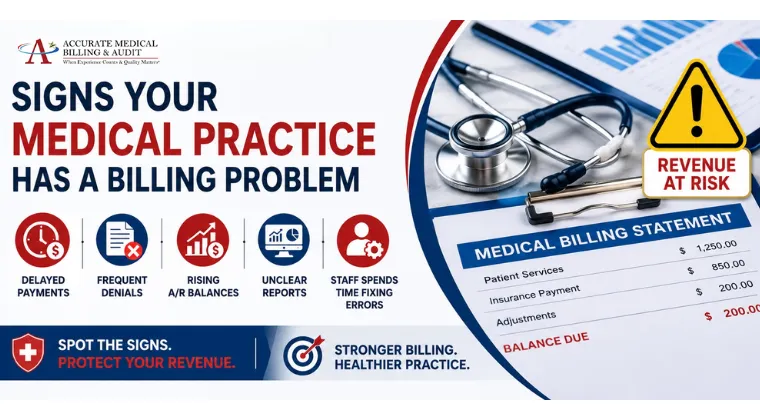
The process doesn’t usually start with anything sensational. There are no alarm bells ringing; there is no dramatic crash. It just starts happening in small ways until “that’s just how things work.” What used to be a two-week process now becomes a four-week process and then a six-week process. A few denials start creeping up, but they remain manageable.
That’s usually where it hides, right in front of you. A billing problem doesn’t announce itself. It builds up slowly and quietly.
For many medical practices, the real challenge isn’t providing care. It’s getting fully paid for it. With insurance rules, complex coding, eligibility checks, and documentation demands, the revenue cycle can break down in ways that aren’t always obvious.
This is how this type of breakdown will begin to show its effects in real-life situations.
1. Delayed Payments Begin Coming in
One delayed payment means nothing; however, a trend is very different.
The delay in payments generally indicates a problem in the system, such as claim errors, incomplete or insufficient information, or poor submission. Claims free of errors must be paid out within a few weeks, but delayed processing can last even longer.
The issue with this is that, even though the practice is still being paid, it does not seem immediately necessary. However, these delays can have subtle negative effects on cash flow and planning. Inconvenience turns into instability.
2. Denials Are Becoming Routine Instead of Rare
Denials are common, but that’s okay. What isn’t okay, however, is when they become predictable. When denials occur frequently, they may indicate problems such as incorrect coding, documentation, or eligibility issues during the intake process.
And once denials become routine within the weekly process, something happens within the practice itself:
- The practice spends more time disputing than submitting
- Payments are delayed or denied altogether
- Appeals accumulate and expire unnoticed
It’s not just extra paperwork. It’s money that never fully comes in.
3. Accounts Receivable Keeps Growing, Especially Older Balances
A healthy revenue cycle doesn’t let claims sit for long. So when accounts receivable, especially those over 60 or 90 days, start piling up, it’s a sign that follow-up systems aren’t working well.
Unresolved claims don’t just sit harmlessly. They get older, and the longer they wait, the less likely you are to collect the full amount.
What usually drives this?
- Weak denial management processes
- Delayed claim resubmissions
- Inconsistent payer follow-up
Over time, accounts receivable turns from just a report into a real backlog problem.
4. Financial Reports Exist, But Don’t Explain Much
Having information does not mean that you understand everything.
Many medical billing practices get detailed reports each month, but cannot answer fundamental questions such as:
What usually drives this?
- What payers are underperforming?
- At which point is there a backlog of claim submissions?
- Why are there denials for this month?
- Are we losing money because of under-payments post-payment?
Without those details, leaders are basically making decisions without all the facts. In billing, what you don’t see often ends up costing you.
5. Staff Are Constantly Fixing Errors Instead of Preventing Them
If billing teams spend most of their time fixing problems, something earlier in the process isn’t working.
Instead of smooth workflows, the day becomes reactive:
- Resubmission of denied claims
- Following up on missing documentation
- Fixing coding/patient data errors
- Payor rework requests
Such an environment not only slows things down but also takes its toll on employees. The result is burnout, staff attrition, and inconsistent performance. Billing processes that work well streamline operations, while those that don’t cause frustration.
6. Revenue Down Despite No Change in Patient Traffic
This is probably the most frustrating sign for doctors managing their practices. The calendar is packed with appointments, and patients are receiving treatments. However, payments do not reflect the amount of work done. In this case, the reason is not clinical, but financial.
Common causes include:
- Increased denial rates
- Under-coding or missed charges
- Unresolved claims in aging A/R
- Underpayments that go unnoticed
Research on revenue cycle performance shows that even small problems can lead to significant revenue losses over the course of a year if left unaddressed. In other words, the work is getting done, but the payment isn’t always keeping up.
7. Billing Complaints from Patients are on the Rise
If there is confusion about the office’s billing system, the patient will definitely notice. Confusing bills, unexplained charges, and conflicting information in the front office all point to issues with the billing procedure.
Patients start asking more questions, staff spend more time explaining, and disputes become common. A good billing system reduces confusion. A struggling one causes it.
8. Coding Corrections and Rework Are Happening Too Often
Every error that has been corrected results in lost time and delayed revenue.
Frequent errors are indicative of one of these three major areas:
- Poor documentation
- Poor code review
- Outdated workflow
Small errors made in coding can eventually result in substantial financial losses, particularly when there is undetected under-coding or inappropriate use of modifiers. In terms of coding errors, the problem is not so much their occurrence as their repetition.
9. You Don’t Have a Clear View of What’s Actually Being Lost
Perhaps the most important sign is also the easiest to miss. Many practices assume they’re “doing fine” because money is still coming in.
But without structured audits, it’s nearly impossible to see what’s being left behind:
- Unworked denials
- Missed charges
- Underpayments
- Expired claims
Industry findings show that much of the revenue loss in healthcare goes unnoticed without formal audits. If the system isn’t tracking what’s lost, it’s probably just absorbing those losses.
A Final Word from Accurate Medical Billing & Audit
Billing issues rarely go away on their own. They grow over time. What starts as small delays can turn into ongoing revenue loss if not addressed. The good news is that most of these problems can be found and fixed once the system is clear.
The main principle at Accurate Medical Billing & Audit is straightforward – we identify where revenue leakage occurs, identify the reasons for such leakage, and provide you with the means to regain control of your billing processes.
In case any of the above situations seem to describe you, then maybe it is time to do something about it.